
The Phonetic Anatomy of the Parisian "R" (And Why You’re Trying Too Hard)
From Edith Piaf’s rolled trill to modern urban glottal friction: unravelling the sound that terrifies English speakers.
01. The Historical Shift from Trilled to Uvular
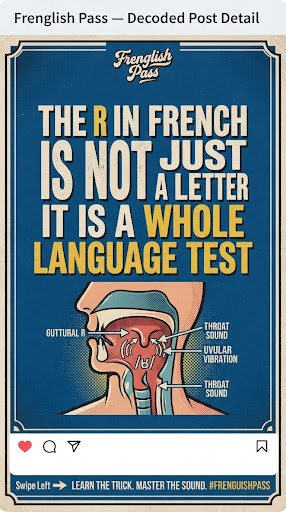
Centuries ago, French people rolled their 'R' at the front of the tongue, much like modern Spanish, Italian, or regional Occitan accents. It wasn’t until the 17th and 18th centuries in Parisian aristocratic salons that the uvular 'R'—originating as an affected stylistic flair—caught fire and spread as the prestigious standard of the capital.
Today, the French uvular fricative /ʁ/ is the hallmark of metropolitan French. The secret is that it requires surprisingly little breath pressure: forcing it produces a guttural German sound, while relaxing produces effortless Parisian fluidity.
Le /ʁ/ Uvulaire
The uvular fricative produced by gentle contact between tongue dorsum and uvula.
Le R Roulé
The front-of-tongue trill. Great for 1930s cabaret songs, confusing in modern boulangeries.
Le R Aspiré
The terminal, almost silent whisper at the end of words like "merci" and "soir".
02. The 3-Step Morning Gargle Practice Routine
Take a tiny sip of water, tilt your head back 45 degrees, and produce the gentlest gargle possible. Feel the exact vibration at the top of your throat. Spit out the water, keep your tongue in the identical position, and repeat the sound. Congratulations: you just produced a textbook Parisian uvular consonant.
03. Top 5 Trap Words That Expose Your Accent
1. Serrurerie (Locksmith) — Four consecutive tricky vowels and R shifts.
2. Écureuil (Squirrel) — The universal Anglo-Saxon tongue-tier.
3. Aurore (Dawn) — Triple throat roll.
4. Grenouille (Frog) — Soft palate gymnastics.
5. Rue de Rivoli (Iconic Paris street) — Order a taxi and pray!
Want to experience native French fluently?
In the Frenglish Pass Adult Course, we dive deep into real native expressions, street slang, bistro banter, and everyday paperwork survival without tears.